Life · July 26, 2026
A Game That Cannot Be Gamed
Finishing the San Francisco First Half Marathon, six months after a 10K got me hooked.
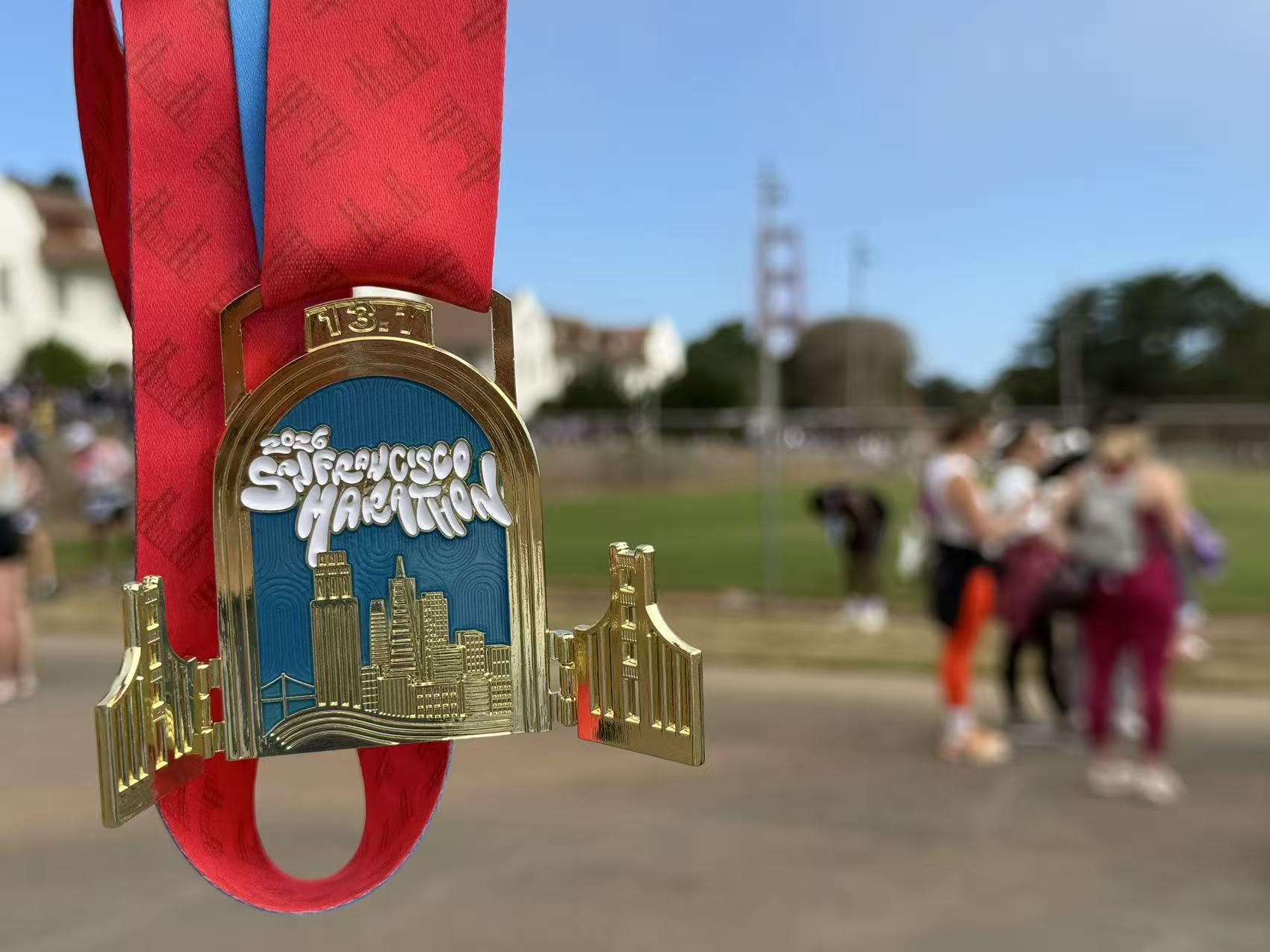
Yesterday I crossed the finish line of the San Francisco Marathon’s First Half — 13.1 miles, starting on the Embarcadero in the dark at 6:46 a.m. and ending 2:44:20 later. A 12:33 pace. Nobody is going to confuse me with an athlete. I have never been happier with a number.
I almost didn’t show up. I had just spent over a week in Alaska doing intensive hiking, and my flight landed on Saturday — the night before the race. Legs already spent, sleep in short supply, and a very persuasive voice suggesting that skipping would be the sensible thing. Standing at the start line the next morning, I was glad I hadn’t listened. Half of this sport, it turns out, is just showing up when you have a perfectly good excuse not to.
Where this started
This journey began on January 11, 2026, at a Hot Chocolate Run 10K. I signed up mostly out of curiosity, and what got me wasn’t the running — it was the energy. Thousands of people of every shape, size, and age, all in love with the same sport, all showing up in the cold morning anyway. I had quietly assumed sport belonged to a certain kind of body. That morning disagreed. I wanted to come back.
Which surprised me, because I have never been a sports person. Growing up in Asia, sport was something you were tested on, not something you did for joy. The 800-meter fitness test felt like it took forever — two laps that stretched into a small eternity, run purely to get a score and be done with it. If you had told my teenage self that one day I would pay money to run 13.1 miles before sunrise, she would have assumed it was a punishment.
What changed
What changed wasn’t my body. It was patience. Somewhere in growing up I acquired the ability to sit inside something slow and let it unfold, and it turns out that is most of what distance running asks of you.
And once you have the patience, running gives a lot back:
It has almost no barrier. A pair of shoes, and go outside. No court to book, no team to assemble, no skill gate to clear before you’re allowed to participate. You start where you are, as slow as you are.
It gives me time to think. Long runs have become the one protected block in my week where no one can reach me and nothing is urgent. I think about things I never have time to think about — work, family, decisions I’ve been putting off. Some of my clearest thinking now happens at a 12-minute pace.
It repays effort, reliably. 跑步是生活里少数一分耕耘、一分收获的事情 — one of the few things in life where every unit of effort is returned as harvest. So much of adult life is noisy: you can do everything right and still get an outcome decided by luck, timing, or other people. Running isn’t like that. The evidence is unambiguous: my heart rate at the same pace has drifted lower and lower over the months, a quiet ledger of every run banked. Put in the miles and the body answers — no politics, no luck, no negotiation. It gives me something I find almost nowhere else: moments of feeling fully in control of my own life. There is something deeply restful about a game that cannot be gamed.
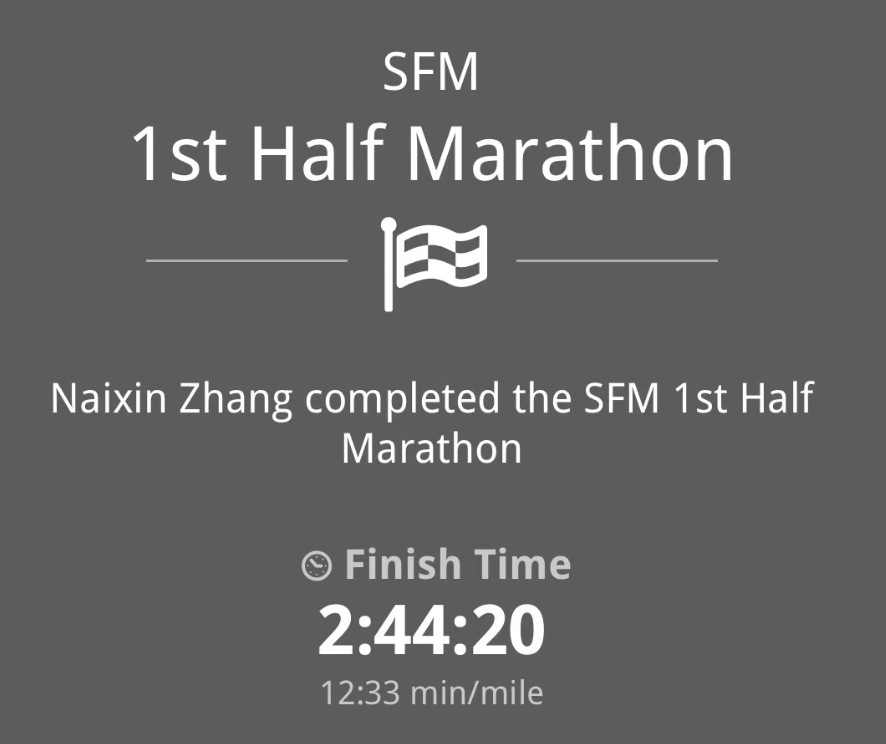
Still slow, still winning
I am still slow. Most of the field finished ahead of me, and that’s fine — they were never who I was racing. The runner I’m racing is the person who stood at that 10K start line six months ago, and the teenager who dreaded two laps of a track. Against them, I win by miles.
And beneath all of it, gratitude. A body that can be trained to carry me 13.1 miles is not something I built from scratch — it is something my parents gave me. Being able to run at all is a privilege, one most of us never notice because it has never been taken away. I’m trying to notice it now, on every run. Every finish line is partly theirs.
Next up: the Monterey Bay Half in November. See you there.